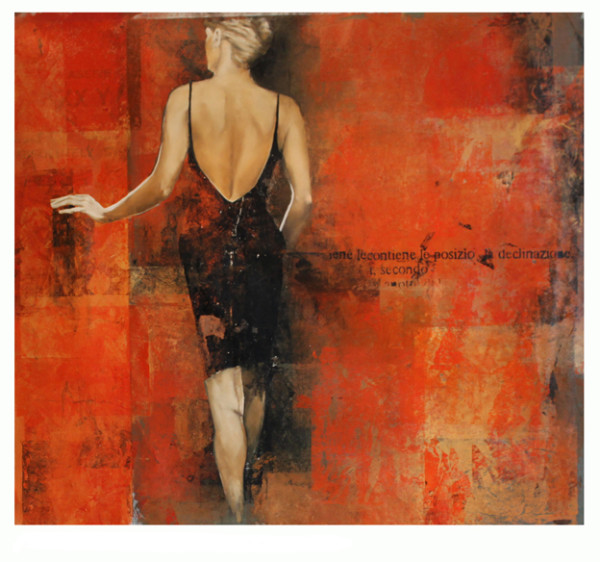
Crossing Line by Margit Füreder, Oil on Canvas, 52″ x 59″
Every month, we will be riffing on a different color. In keeping with the change of season, this month’s color is orange.
As it is coming on to autumn with all its brisk enlivening display, the color focus this month is orange. It is interesting that all the autumnal colors are warm, even as the days grow cooler and finally cold, wrapping us in vibrancy. Before all goes white, we first have the brilliance of autumn; glowing and ripe, like the delicious citrus of the orange.
Not only do we have oranges but we have all these other delicious orange fruits; tangerines, nectarines, apricots and peaches. The orange color of fruits, vegetables and autumn leaves comes from carotene, a type of photosynthetic pigment. When the weather turns cold and the green chlorophyll stops flowing, the orange color remains.
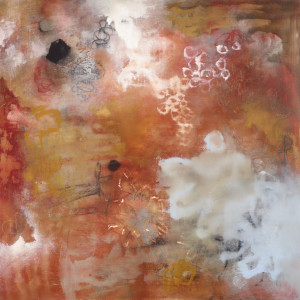
Ferocious by Barbara Fisher, Oil on Panel, 30″ x 30″
The color orange stimulates activity, appetite, and encourages socialization. Orange also seems to spark more controversy than any other hue; you either love it or hate it. The tints of orange like terra cotta, peach, salmon, and rust have a broader appeal. The color is less primitive than red. It is mellower, and when reflected on our skin, orange casts a cheerful and flattering glow. Frank Sinatra said, “Orange is the happiest color.”
Orange is considered fun and flamboyant, radiating warmth and energy. The other day, I painted the door of our new garden shed a bright orange. It was a daring thing to do and took me days before I grew to love it. Everyone who sees it laughs. The door seems to brighten people up. Even a friend whose taste is decidedly monochromatic (her house is, inside and out, shades of white) loves it.
In the 17th century, Newton related colors to the notes of the diatonic scale; seven distinct pitches. He wrote that D is the note for orange. Color also has form, and orange is considered the form of a rectangle. Orange helps focus the eye and lends itself to angles and details. In heraldry, orange was the symbol for strength and endurance, called tenné. In Buddhism, orange (or more precisely saffron) is the color of illumination, the highest state of perfection.
Lakeside View by Johanne Yordan, Mixed Media on Canvas, 40″ x 60″
In 1750, the recipe for Stradivarius’ radiant orange violin varnish was lost. Even today, violinmakers are still trying to recreate that quality of varnish. Ancient Egyptians used the safflower to dye their mummy wrappings and to turn ceremonial ointments an oily orange. During the Ottoman Empire, the richest orange red was derived from the pink roots of the madder bush. Madder is usually considered a bright pink paint, but if you put white wool in a madder dye bath, with alum, the result is the exuberant orange of a redhead. Synthetic dyes contain only one color, but in madder there is also blue and yellow, along with the red.
In Theory of Colours, Goethe wrote, “As no colour can be considered as stationary, so we can very easily augment yellow into reddish by condensing or darkening it. The colour increases in energy, and appears in red-yellow more powerful and splendid… The red-yellow gives an impression of warmth and gladness, since it represents the hue of the intenser glow of fire, and the milder radiance of the setting sun… The agreeable, cheerful sensation which red-yellow excites, increases to an intolerably powerful impression in bright yellow-red.”
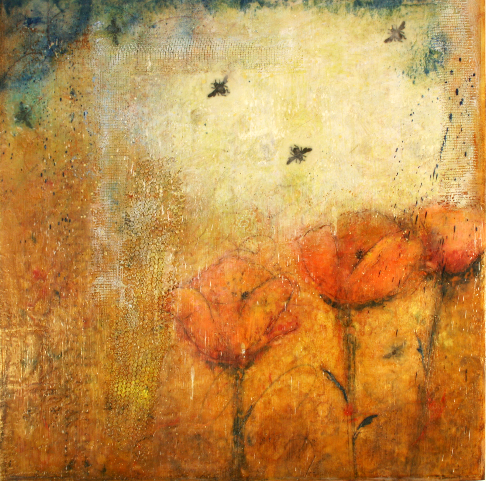
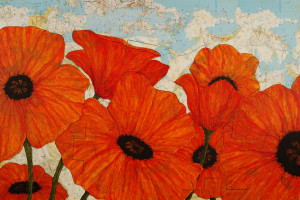
Poppies by Jessie Pollock, Encaustic on Panel, 24″ x 24″
No color stands alone. Colors are active. Color is what it is by its interaction with other colors; what happens between colors. Blue is the complementary color of orange and these two colors reinforce one another. “You can push light and/or hue by the use of contrasts,” Josef Albers wrote. “Usually we think of an apple being red. This is not the same red as that of a cherry or tomato. A lemon is yellow and an orange like its name. Bricks vary from beige to yellow to orange, and from ochre to brown to deep violet. Foliage appears in numerous shades of green. In all these cases the colors named are surface colors. In our perception, colors continuously interact.”
Renoir frequently placed orange against azure or cobalt blue to make both colors appear brighter. Van Gogh wrote that in his paintings he was trying to reveal “the oppositions of blue with orange, of red with green, of yellow with violet… trying to make the colours intense and not a harmony of grey… There is no orange without blue.” Orange pigments are largely in the ochre or cadmium families, and absorb mostly blue light. In the realm of geology, Carnelian, Fire Opal and Amber are all considered orange stones.
Wassily Kandinsky wrote, “Orange is red brought nearer to humanity by yellow.” Orange is alive, vibrating and unique. Did you know that redheads might become extinct in the next 100 years? That’s what genetic scientists are warning, while others are debunking that claim. Still, only one to two percent of the world’s population has red/orange hair. Orange is rare. It is also joyful and full of life.
“Dance the orange. Who can forget it?
How it, drowning in itself,
rejected sweetness. You have possessed it.
It deliciously converted itself to you.
Dance the orange. The warmer landscape, throw it
out from you so that the ripeness might gleam
in these skies from home! Illuminated ones, unveil
aromas among aromas! Achieve this relation
with pure resilient peel,
with the nectar that fills the fortunate one!”
- “Sonnets to Orpheus” by Rainer Maria Rilke, Part I, #15