
This essay originally appeared in the catalog Duncan Johnson which accompanies the August 16-October 31, 2014 exhibition “Stone. Glass. Wood.” at the West Branch Gallery & Sculpture Park.
Duncan Johnson: Reaching Across History
By Ric Kasini Kadour
Every work of art poses some basic questions to the viewer. What is it? What does it show? Who made it? Why did the artist make it? And some art—that art which is more complex, perhaps more sophisticated, or simply difficult to look at or understand—raises other questions. Where does the art fit into the broader visual landscape? How is the artwork related to the larger narrative of art history? One doesn’t need to answer all of these questions to enjoy a work of art or even to understand and appreciate it, but asking these questions can make art a deeper, more meaningful experience.
With some artwork, these questions can turn what appears to be a simple gesture into bold operatic movements that reach across history and connect the viewer to a broad spectrum of humanity. The wood-on-panel works by Duncan Johnson are examples of that.
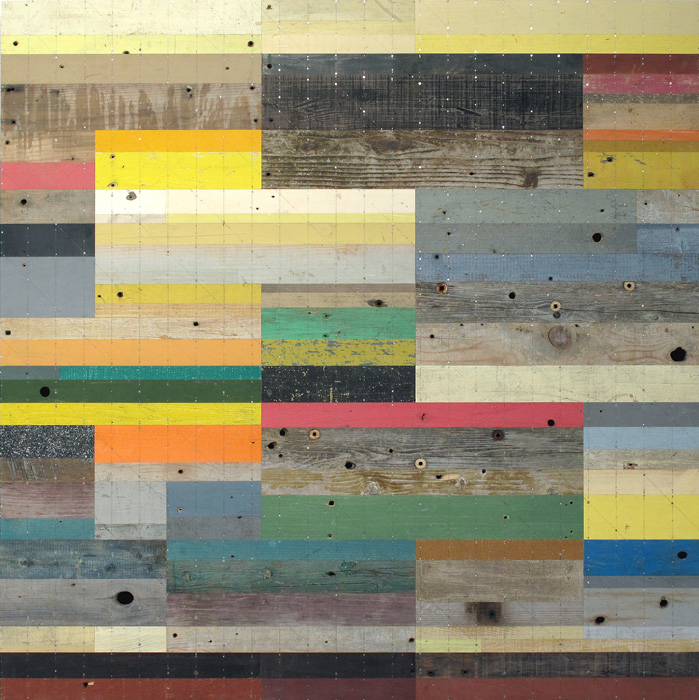
Johnson gathers wood from construction sites, landfills, and other stockpiles around his home in Vermont’s Upper Valley and converts the refuse into colorful, two-dimensional works that hover somewhere between painting, sculpture, and collage. The success of Johnson’s wood paintings are rooted in the harmonious joining together of his source material. They are marked by expert craftsmanship and skilled woodworking. In Badger, dozens of pieces of wood fit seamlessly together. Some of the wood is raw and untreated, some was painted long ago when it was initially put to use. The colors bounce from yellow to red to orange and green with a few blue and other off-color pieces. Lines run horizontally and vary in width and height. Badger feels like a puzzle that the artist had figured out how to assemble.
Johnson’s wood panels speak a visual language that is familiar to the contemporary viewer. For over a hundred years, painters have used stripes, bars, and color to explore two-dimensional composition. One can see in them Piet Mondrian’s intersecting/interacting lines and blocks, Pat Lipsky’s rhythmic use of color, and Sean Scully’s tireless exploration of texture. These compositions speak to us because we think of our world theoretically and non-representational gestures reflect that. Ironically, however, these compositions also allow us to free associate what we are looking at with aspects of our world: textiles, patterns, digital bits, and so on. They allow mind to play as the viewer explores the painting.
While Johnson’s process is similar to collage, his work synthesizes a number of 20th century ideas about painting and sculpture. Johnson prepares pieces of wood by milling the pieces down to equal thickness. They sit in piles and bins in his studio. When he is ready to assemble a wood painting, he roots through his supply and begins selecting pieces. He arranges the pieces, responding to how pieces react to one another when placed side by side. When he arrives at a composition that pleases him, he glues and nails down the pieces. Because he is concerned with the spatial presence of objects and how they interact with their material presence, Johnson is working like an early 20th century Russian Constructivist. But Johnson works intuitively and is less interested in theoretical rigidity. He 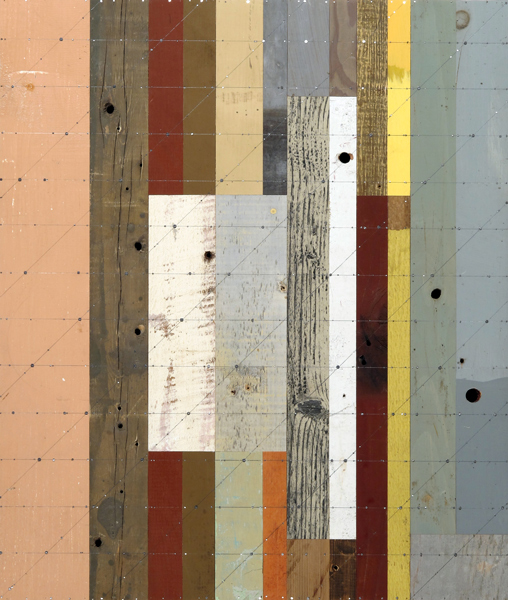 draws on his own visual fluency. Simply calling him a Constructivist oversimplifies what is going on in the work. A better comparison is the painter Agnes Martin, who used lines and grids and a minimal use of color to lead the viewer to an almost transcendental reality.
Multiple histories play out in Johnson’s work: the artist’s personal history, the history of the material, the history of the composition. The complexity of the panels gives the viewer a number of entry points. One could start with imagining the original use of the wood. One could imagine that the bar of salmon-colored wood on the left side of Quiver is the remnant of a kitchen cabinet that, long ago, a proud housewife picked out only to regret the decision as the reality of living with salmon-pink cabinets set in. Johnson starts Quiver with color, but then moves on to a strip of weathered wood that could have come from a barn, then a strip of maroon that is interrupted by a block of white, and so on. Like watching people in a train station, each piece in Johnson’s wood panels tells a story. Assembled, they tell dozens.
CATALOG AVAILABLE